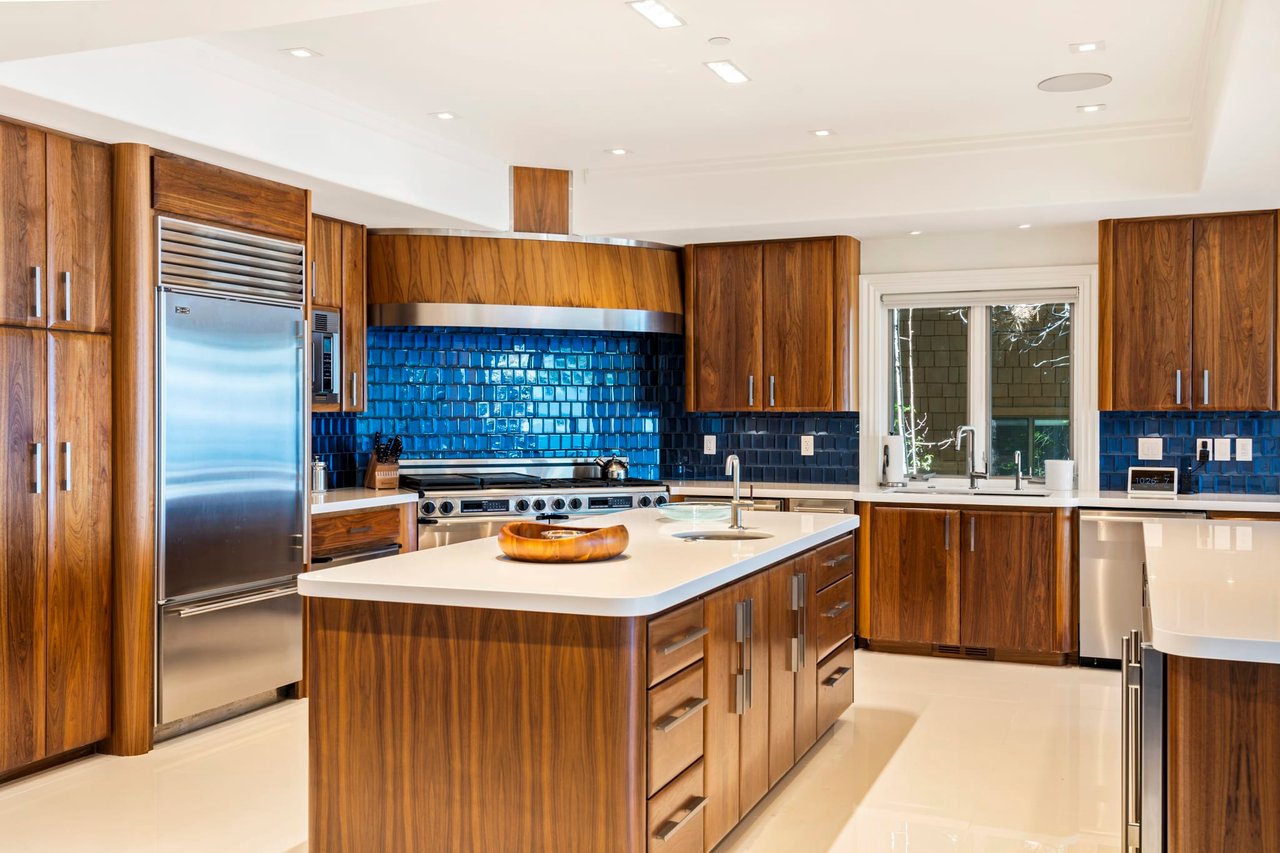
Why Cedarbrook Doesn't Behave Like a Real Estate Market
A buyer scrolling East Shore listings pulls up Cedarbrook and looks for the numbers that work everywhere else on Lake Tahoe: median price, days on market, price per square foot measured against the last dozen closings. None of it holds together, because there is no dozen. Cedarbrook is a collection of 8 distinguished residences tucked into a private, forested pocket of Nevada's East Shore, each with its own stretch of sandy beach. Run any standard real estate metric on a pool that small and the sample size collapses before you get an answer worth trusting.
Zoom out one street and the picture doesn't get much bigger. Logan Creek, the neighboring enclave that local listing data often groups with Cedarbrook under a single small-area heading, is home to just 22 residents, bordered by U.S. Forest Service land on three sides, with the actual Logan Creek running through the properties. It's also, by local accounts, the only one-acre community in the entire Tahoe Basin. Two neighborhoods, both genuinely rare, both too thin on their own to produce a statistic anyone should build a decision around.
That's the fact worth sitting with before comparing Cedarbrook to anywhere else on the East Shore. This isn't a small market. It isn't a market in the way Glenbrook or Zephyr Cove or Lakeridge are markets, with enough turnover to draw a trend line through. There isn't enough activity here to generate a market in the statistical sense at all, and that changes what you should actually be evaluating when one of these eight homes comes up for sale.
Real estate pricing normally leans on comparable sales: enough transactions in a defined area to average out the noise from any single deal. Glenbrook, a few minutes up the shoreline, has 297 residences and 61 lakefront parcels, which is a large enough pool to produce a real median and a real sense of pace. Cedarbrook and Logan Creek don't have that luxury. When a property here sells, it isn't one data point among many. It's frequently the only data point available for years.
| Community | Scale, per local data | What that means for comps |
|---|---|---|
| Cedarbrook | 8 total residences | Too few sales to establish an independent price trend |
| Logan Creek | 22 residents on USFS-bordered lots | Grouped with Cedarbrook in listing data; still too thin to comp on its own |
| Glenbrook (for contrast) | 297 residences, 61 lakefront parcels | Enough volume to generate a genuine median and trend line |
The temptation is to borrow a per-square-foot figure from a larger, better-documented neighborhood nearby and apply it here. That borrowed number assumes a liquidity that Cedarbrook simply doesn't have.
The other reason Cedarbrook resists normal pricing logic has nothing to do with square footage and everything to do with a regulatory freeze that outlived most of the homes currently standing on the East Shore.
The Tahoe Regional Planning Agency began regulating the lake's shoreline in 1976 through a system of tolerance zones. In 1987, growing concern over fish habitat led the agency to prohibit new shorezone structures outright, effectively halting new pier construction across the entire basin. Attempts to revise the rule in 1995, 1999, and 2004 went nowhere. A shorezone ordinance finally passed in 2008, only to be overturned by a 2010 lawsuit brought by the League to Save Lake Tahoe and the Sierra Club. The moratorium held until October 2018, when TRPA's Governing Board approved a new Shoreline Plan that finally lifted it and replaced the old stalemate with a structured allocation system: a Pier Lottery and Prioritization held every two years on odd years, and a Mooring Lottery held annually.
Do the arithmetic on that timeline and you get 31 years, from 1987 to 2018, during which essentially no new private pier could legally go into the lake. Since 2018, a limited number of new piers and moorings do come through the lottery, but the pool is capped and the odds are long. An existing, properly permitted pier on a home built or established before that freeze isn't something you can plan to add later. It's something you either buy with the house or you don't get at all.
In a neighborhood this small, the primary driver of value isn't the remodel or the finish level. It's whether the specific parcel carries a permitted pier, mooring, or protected shoreline access, and whether the paperwork proves that right actually transfers with the title rather than resting on an informal understanding with neighbors. Every home in Cedarbrook is built around direct, private beach frontage, which is exactly the kind of shorezone asset that hasn't been freely issuable for most of the last four decades.
Before writing an offer on a home in Cedarbrook or Logan Creek, it's worth confirming a short list of things that matter more here than they would in a larger, faster-moving neighborhood:
Even within the same stretch of shoreline and under the same TRPA rules, scale changes what a number means. Glenbrook's size gives buyers real reference points. In April 2026, a 4,100-square-foot custom home in Glenbrook's gated Uppaway Estates development, built around a shared community pier, boat mooring, and lakeside park, listed at $4,995,000. That figure is useful precisely because Glenbrook has enough transaction volume for a price like that to sit inside a pattern rather than stand alone.
Cedarbrook has no equivalent pattern to check a number against. Pulling a per-square-foot figure from Glenbrook, or from the broader East Shore lakefront category, and applying it to one of Cedarbrook's eight homes treats two fundamentally different kinds of scarcity as if they were the same thing. One is scarce because demand is high relative to a large but finite pool. The other is scarce because the pool itself is barely large enough to count.
If what you want is liquidity, a real trend line, and enough recent activity to negotiate with confidence, larger East Shore communities will serve you better simply because there's more data to work with. If what you actually want is one of the last functioning, pre-1987 shorezone rights on this side of the lake, attached to a genuinely private beach, Cedarbrook or Logan Creek may be the only place that specific asset exists in the size and setting you're picturing. The price on that kind of property should be weighed against its scarcity within a regulatory system that stopped reliably producing more of it decades ago, not against a median pulled from somewhere else on the shoreline.
Is Cedarbrook the same neighborhood as Logan Creek? They're distinct enclaves, but local listing systems frequently group them under one small-area heading because each is too small to generate reliable data on its own.
Can I add a pier if the Cedarbrook home I'm considering doesn't already have one? Possibly, through TRPA's Pier Lottery and Prioritization process held every two years on odd years, or the annual Mooring Lottery. Both draw from a capped pool, so approval isn't guaranteed and shouldn't be assumed when budgeting for the purchase.
Why don't Cedarbrook prices show up in standard East Shore market reports? With only eight total residences, sales are infrequent enough that any market report built on Cedarbrook alone would be describing one or two transactions, not a trend. That's also why it's frequently folded into broader East Shore or Logan Creek-Cedarbrook categories rather than tracked on its own.
Cedarbrook rewards a different kind of homework than most East Shore neighborhoods. If you're weighing a purchase here, or trying to understand what a shorezone right attached to one of these eight parcels is genuinely worth, The Zager Group has spent decades tracking the East Shore's smallest, least liquid corners alongside its larger ones. Request a Private Lake Tahoe Market Consultation to talk through what a specific Cedarbrook or Logan Creek property actually carries before you compare it to anywhere else on the lake.





Get In Touch